
Go Deaf. Keep Writing.
A personal essay on fear and creativity, A.I. and birdsong, and the uses and misuses of hyperbole

I woke this morning to the solitary cheep of a pine siskin. Just one. Soon, more birds would wake: warblers and juncos, sparrows and finches. It was there, in the gray, almost-but-not-quiet silence of pre-dawn, that I found myself startled by the date: May 1st.
It’s finally, wonderfully, May. In May, everything feels possible. The world is a wandering path, waiting to be tread. In two weeks, I will be heading to a writing conference and visiting friends and family, most dear. In four weeks, my children will begin their summer. Knowing this adventure awaits changes everything.
Meanwhile, the blue sky is smothered in clouds, and dewdrops cling to the long blades of the daylilies. The birds swoop through the golden air, and the school bells call to the children: run, run through the ponderosa wood, run down to school.
The morning passes, but not the feeling of May. I am now sitting in my office, hands a bit numb (why is my office always so cold?), pondering over what I have learned this week about writing, and about life.
Humor. Despair. Kindness. Hope.
All of it, mixed together.

This week, I meant to study humor, and I studied hyperbole instead.
It started with my friend Kathy’s book, Write with Jane Austen, but soon wandered into the soft paper-bound pages of Donald Maass’s The Fire in Fiction. How does humor work, I wondered. Is it an alchemy that can be learned?
Humor, it seems, relies on abusing expectations. Take what the expected truth and twist it, exaggerate it, stomp on it like a toddler smashing a bubble with their feet.
In short, be playful.
I am good at playing and exaggerating, both. I tease, I moan, I complain loudly. I stomp around the wooden floors of my house, abusing the air, while my 10-year-old crashes into my gut. I tell my children they are all terrible. They giggle.
Later, in the bright sunlight of my sunroom, I sort my way through the words in Kathy’s book—Auxesis, Hyperbole, and Bomphiologia. I twist my tongue into knots trying to say them. (They are easier to sing. Try it.)
If you are not fluent in Latin (alas, I am not), here are their definitions:
Auxesis: mere exaggeration.
Hyperbole: grand exaggeration
Bomphiologia (bom-phi-o-lo-gia): self-aggrandizement, that is also exaggeration.
I copy the words with careful letters into my notebook, cross-checking for spelling not once but thrice. An image pops into my mind: a trio of ducks arguing about a puppy.
Auxesis: “Run, it’s a dog!”
Hyperbole: “No, it’s a wolf!”
Bomphiologia: “I’ve eaten a wolf.”
While I took art in high school and a tiny bit in college, I never moved past the “see a picture, copy a picture” phase. My ducks are balls and sticks. Balls for the head, balls for the body, triangles for the mouth, sticks for the legs.
Normally, I would have laughed at the idea and moved on. What I saw in my mind could not come out of my hands, because I hadn’t learned how to draw. Not really.
Except.
Except, I did draw them.
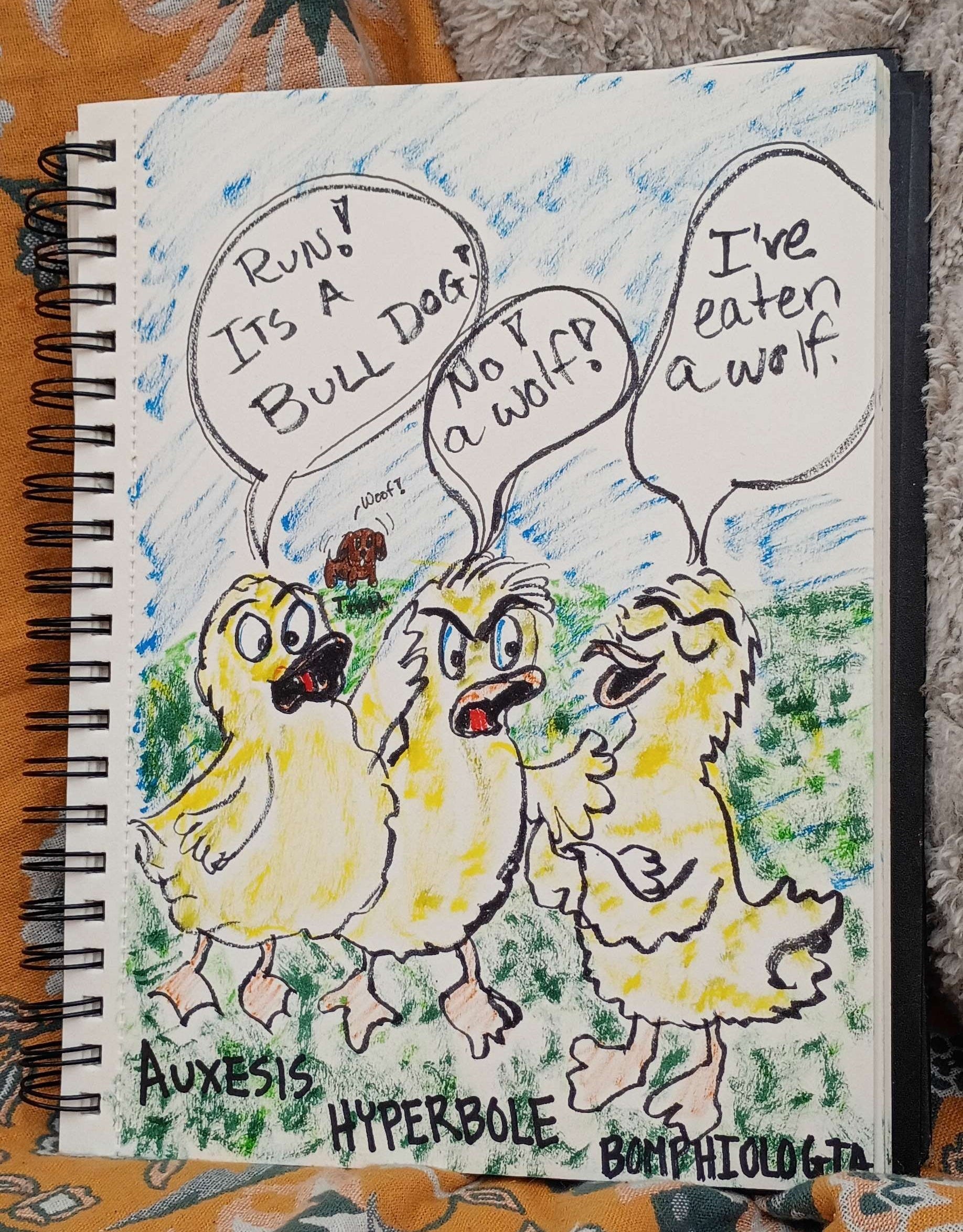
Before I tell you how (and yes, I am as proud as a kindergartener of this drawing), let’s talk more about Hyperbole.
Hyperbole will make us laugh, but it will also jerk at our attention. Hyperbole is a classic clickbait trick—overstate the truth and draw the crowds. Here are some hyperbolic Substack headlines from the week:
Death by A.I.
A.I. is a Selfish Being
Reject the Gilded Cage Promises of A.I.
The 3 Human Skills that Will Keep A.I. from Breaking the World
These titles are all written on the calmest social media platform in the world (I shudder to think what’s happening on Facebook). I am sure they got views. But I wonder at the cost.
Our amygdala is very literal. It sees hyperbole and floods the body with fear: A.I. is a selfish “being” that will trap you, kill you, and break the world!!! Run! Hide! (STOP WRITING!)
We go to bed at night, worried about the future, worried that this new and shiny and strange thing will kill us, cage us, replace us. If it’s not A.I., we fear the “death of middle grade”, the endless advice on querying, the essays on how long and hard the road to publication is.
Fear is meant to protect us, keep us safe.
But fear caused by hyperbole? What good does it even do for us?
Back to my humor ducks. When I first gathered my markers and started to draw, I knew, already, that I wasn’t going to be able to give my idea justice. Circles and sticks. Blah.
But I’ve been playing with ChatGPT lately.
And I had an idea.
“Can you sketch three cartoon ducks in the foreground of a picture?” I typed.
“They are arguing, feathers are flying. One says (in speech bubbles) "Run! It’s a bull dog!" The 2nd: “No, it's a wolf!" The third "I’ve eaten a wolf."
In the background, have a tiny puppy wagging its tail.
I want to draw this, but I'm not good at perspective. Make it something I can replicate easily with markers.”
This its glorious (ha!) sketch:
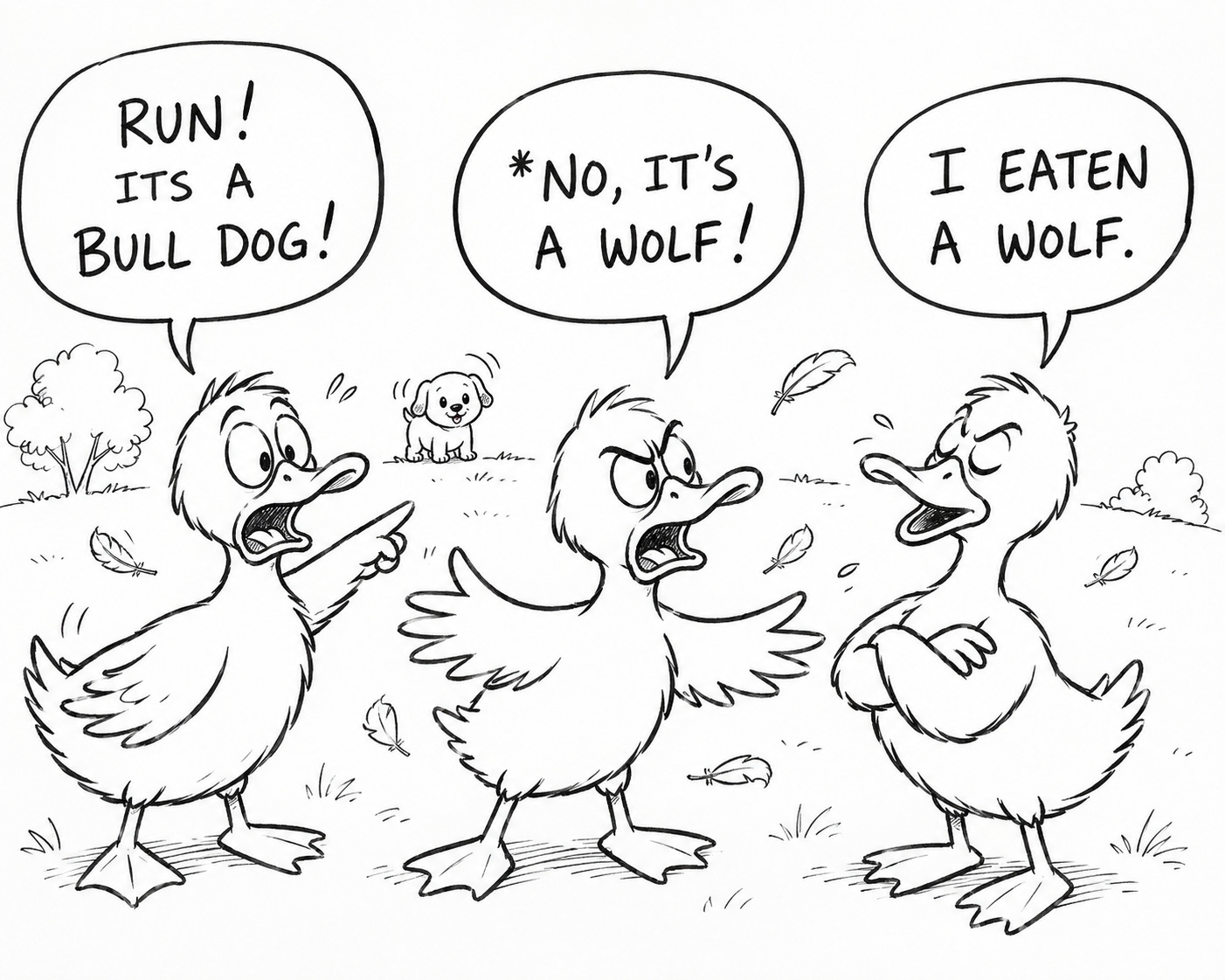
I say “glorious” because, of course, this is a rather silly drawing, too perfect, too generic to be anything but A.I.. But with it as a reference, I made my humor ducks, just about the way I imagined them.
I can’t remember the last time I had so much fun.
I get the fear around A.I., I really do. But also, when I see the headlines, I think: hyperbole.
Art is not a method; it is a way of seeing. It is not a medium, it is an expression of humanity. A.I. can’t do that. But that doesn’t mean it doesn’t have its place.
I teach parkour. Every Monday and Wednesday, I teach children how to jump, spin, and leap over padded blocks that fully grown adults would fumble to climb. These stumbling blocks become not just stepping stones—they become springboards. This is how I use A.I., not as a replacement for creativity. Not as a crutch. As a springboard.
This requires discernment, of course. There remains the question of fairness and openness; when and how, who and what. But what if we made those choices rationally—not from a place of fear?
One last story.
Old Testament Egypt. The time of the pharaohs.
The Israelites are running for their lives. Pharaoh released them, but Pharaoh cannot be trusted. The chariots storm across the sand. Moses pleads with his people to keep walking. They stand at the edge of the Red Sea and despair.
There is no escape.
I can’t help but imagine it. The children’s stumbling feet. The mothers with arms filled with babies, the pregnant women clutching their bellies, fathers reaching for their cudgels and scythes. Nothing so crude will save them from the bows, the swords, and the axes of the Egyptian chariots.
It would be better if we had stayed, they said. It would be better if we had remained slaves.
Into this calamity of fear, Moses hurled a powerful word: תַּחֲרִשׁוּן.
Ta-ha-ri-sun.
Translated literally, it means: to be deaf.
“The Lord shall fight for you…and ye shall be deaf.”
Or, as more commonly translated:
“The Lord shall fight for you…and ye shall hold your peace.”
There are so many voices, aren’t there? They claim that everything is wrong, that we are wrong, that the world is ending. Here is a secret: humans have been fearing the end of the world for centuries.
Last time I checked, the rain is still falling.
The world isn’t perfect.
Humans keep trying.
But how are we to leap, spin, and fly over the stumbling blocks if we’re too afraid to run? To think, to reason, to keep walking forward, we must hold our peace.
So go deaf. Ignore the voices outside of you that whisper “there is not point, it’s already broken”. Ignore the scared inner voice that murmurs, “it’s no use writing, it won’t matter anyway, you’ll never get published”. Unsubscribe from the cynicism. Delete the hyperbolic news articles. Block the end-of-the-world notifications. Go deaf.
Then watch. You might just see a Red Sea part.
Keep writing forward,
- Rachel
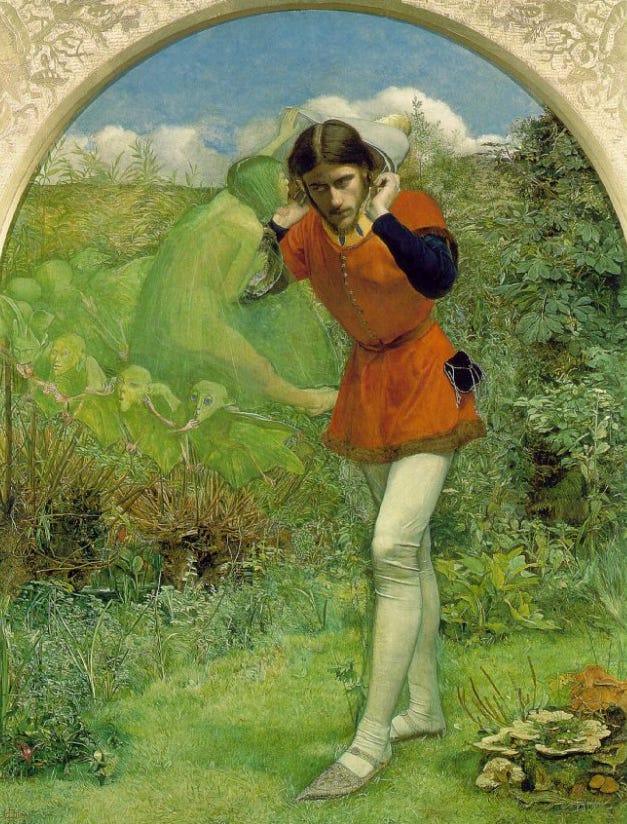
P.S. Artist of the week: John Everett Millais was an English painter and illustrator. He was the youngest student to enter the Royal Academy Schools. I love the vivid details in his paintings and the emotion he captures. Find more of his art at wikiart.org.
Oh, to meet, crashing, headlong into a mind like mine in this frenzy of manufactured “intelligence” is a fantastic surprise, today. I see you. (And the Red Sea never saw us coming - THAT parting is such sweet solace - today, I’m DEAF to sorrow!) ❤️ https://awethenticintelligence.substack.com/p/the-pull-of-push?r=8c15qc&utm_medium=ios
I didn’t want you to feel the pain of shouting into the void, so, here I am, friend, to witness your cocreative journey and bask in your art.