

I used to be a piano teacher with ten students. When I closed my piano studio last fall to focus on my writing, I kept exactly one student: Amanda.* Amanda is the only student I have ever known who, without fail, always practices. When I started teaching her two-and-a-half years ago, she had never touched a piano; she didn’t know what a quarter note was. Now, she’s playing Bach’s minuets.
But there is one assignment that, week after week, continually stymies her: music composition. It’s not that she doesn’t want to write music; she asked to learn. When I asked her what was holding her back, she told me.
“I just want to get it right. I feel like I have to bring you something really good.”
Ever since our lesson, I’ve been thinking about creativity. What it is, and what it is not. And more importantly, how to become more creative?
Creativity: making something new
Creativity is the ability to generate something new: ideas, innovations, solutions, art in its myriad forms. A creative individual can mix disparate ideas, flashes of insight, and new ways of seeing together into something that did not exist before.
Creativity is the vision that comes before the creation.
Craft, however, is the ability to make that vision real.
Amanda excels at craft. She practices her scales, her cadences, her etudes. She bends her ear to her song and listens to her notes with focused, quiet attention. She notices the way her body moves and adjusts; she tucks in her elbows, curves her fingers, and plays until it’s perfect.
But when it’s time to compose? She freezes.
We Need Both CREATIVITY and CRAFT
The truth is, we need both craft and creativity to compose art, music, or story.
Without the combo, you might see a picture in your mind, but be unable to draw it. You could hear a song in your head, but be unable to play it. You could have the best book idea ever, but if you don’t know how to write, it will stay in your imagination, untold.
But if you can’t generate the ideas in the first place? What then?
Creativity Lost
Think back to when you were a child. Maybe five—six? Did you have any problem being creative? My guess is no.
Part of this guess comes from my own experience, teaching and mothering children. But it also comes from a TedX Talk by George Land called “The Failure Of Success”.
As a part of his work for NASA, Dr. George Land conducted a longitudinal study of 1600 children. He claims that 98% of 4 to 5-year-olds he tested were “genius” level divergent thinkers. By contrast, only 2% of adults tested at the same level. (You can watch his Tedx Talk here.)
The drop between the creative children and the not-so-creative adults was gradual, seemingly inevitable. As we age, we go from being able to come up with the most random, ridiculous ideas to only thinking the same thoughts and having the same ideas as everyone else.
Except those 2%.
But how do we reverse this change? (And can it be reversed?)
This week, I heard both my children creating with music.
So how do children create?
I have two stories.
The first comes from an afternoon this week when my son (age 10) and I played mancala. As he moved the little glass pieces from hole to hole, he started humming. Well, humming isn’t exactly right—he was narrating his moves with music. The closest thing I can compare it to is the scene in “The Emperor’s New Groove”, where Kronk is sneaking around, carrying the unconscious Kuzco on his back, while humming his “own theme song.” Without thinking, I started responding to his notes with lines of my own. By the end of the game, we had narrated every victory, every defeat, with an irreverent combination of vocal slides, dips, and trills.
Yes, it was ridiculous. And playful. And so, so fun. And it made me laugh just as much as watching Kronk hum while ‘hiding against the wall’.
And if I had hit the record button on my phone, and then transposed our “mancala theme music jam session” onto the piano?
It would have been awesome.
Alas, I did not.
I did, however, write down the words to the ditty my daughter (age 8) sang to our dog Thursday morning:
Tail up, paws down,
she’s waiting for her walk.
Tail up, paws down,
she always wants a WALK!
(que high note)
Both of these instances of musical creativity came so naturally to my children. So easily. Unconsciously and without thought, even.
And certainly without judgment.
Without the Judgment, we create
And it is this very “unconsciousness” that makes children so able to create. According to Dr. George Land, there are two kinds of thinking that occur in the brain.
The first is divergent thinking: imagination and the generation of new possibilities. (Aka: creativity.)
The second is convergent thinking: testing, analyzing, and deciding, and criticizing your ideas. (Very useful for perfecting the CRAFT of our art; not useful for the creativity.)
The problem comes when we try to do both types of thinking AT THE SAME TIME. When that happens, the neurons in the brain fight each other, and no ideas are formed. Instead, you end up thinking things like We’ve done that before. That’s crazy. That will cost too much. And no new ideas come.
His solution?
Separate the divergent thinking from the convergent thinking.
In short, hold back on your judgment while the inner child is playing.
It’s simple.
But I promise you, it works.

One (small) practice to change this:
If you want to be creative, try this: stop telling yourself (and everyone else) that you aren’t creative.
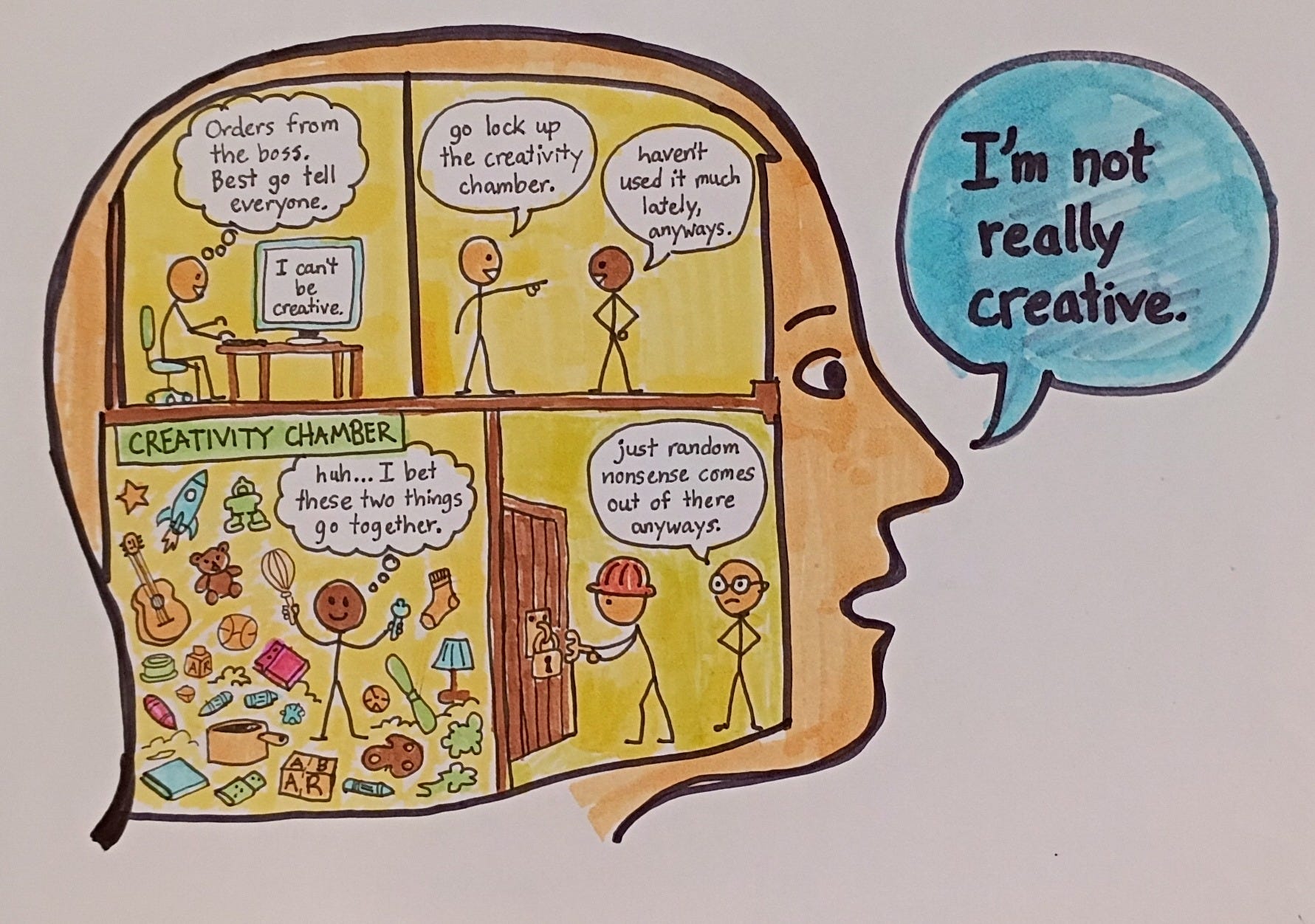
Instead, notice the places where you STILL create, and notice the ideas you DO have. If you haven’t listened to it already, I love this interview with Mel Cook. His four steps to unlocking your creativity are brilliant.
What I’m reading:
When I started my research into creativity this week, I didn’t think I had any books about creativity, per se.
I was wrong.
(I have a very bad habit a delightful habit of searching through the used book store inside my library for craft books. So I have more books on writing than I could possibly read.)
These are the ones I’m skimming this week.
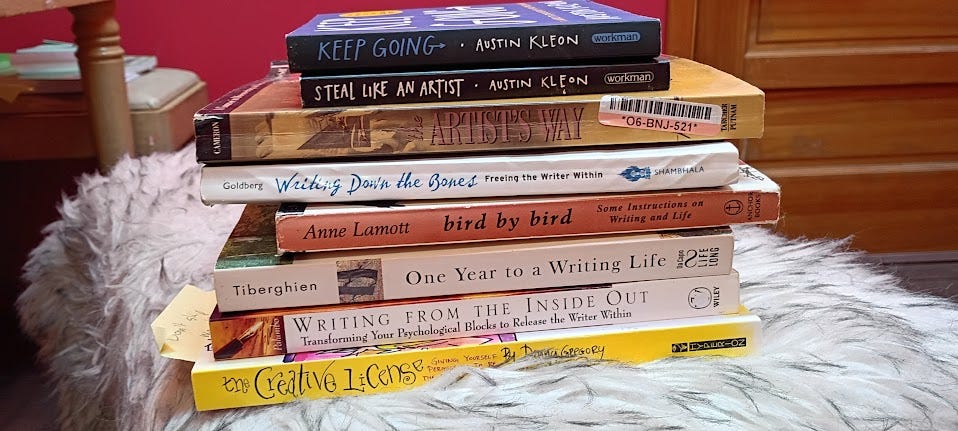
I’m starting with this one.
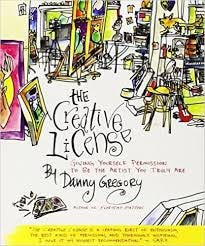
I’m only one chapter in, but I think it’s going to be exactly what I need.
I’m also listening to this book (via libby, thank you, library):
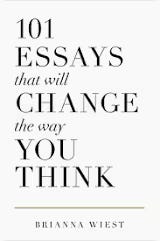
4 essays in, and I’m afraid I’ve found another book I need to own (currently using a library copy). Brianna’s first two essays, on “SUBCONSCIOUS BEHAVIORS that are KEEPING YOU from HAVING THE LIFE YOU WANT” and “The PSYCHOLOGY of DAILY ROUTINE” are brilliant (and very much relate to the sort of things I like to write about). Here’s a quote:
You think that to change your beliefs, you have to adopt a new line of thinking, rather than seek experiences that make that thinking self-evident. A belief is what you know to be true because experience has made it evident to you. If you want to change your life, change your beliefs. If you want to change your beliefs, go out and have experiences that make them real to you. Not the opposite way around.
So go have a creative experience, will you?
Keep Writing Forward,
- Rachel
* Name of student changed to protect privacy.
P.S. The artist of the week is, once again, Sir John Everett Millais.
P.P.S. If you want to see an EXCELLENT example of divergent thinking, check out this interview of author Michelle Rial about her new book “Charts for Babies”. It will give you a good giggle, I promise.
“Instead, notice the places where you STILL create, and notice the ideas you DO have… Go have a creative experience” Resonates with me. I have spells where I go without many creative ideas or urges to write, etc. I often feel like, I lost my creativity, was I ever even creative? Am I creative? Is it gone forever? And then I’ll have another magical moment of freedom where I out of nowhere write a sentence I love, or a doodle that feels write. And it’s back. It takes a creative experience to remember I am creative.
Creativity is the vision that comes before the creation.
Craft, however, is the ability to make that vision real.
I always thought of myself as, “not an artist but a craftsman” as I thought of the artist side as the creative part and the craftsman side as a person who can look at something that has been created and copy but vary the creation to something I craft.
I really appreciate your perspective on the definition of creativity and crafting.
My definition of myself in this regard is evolving as I guess all perspectives do, or should do, as you broaden your world.
Thank you for this piece…and keep writing 🐝